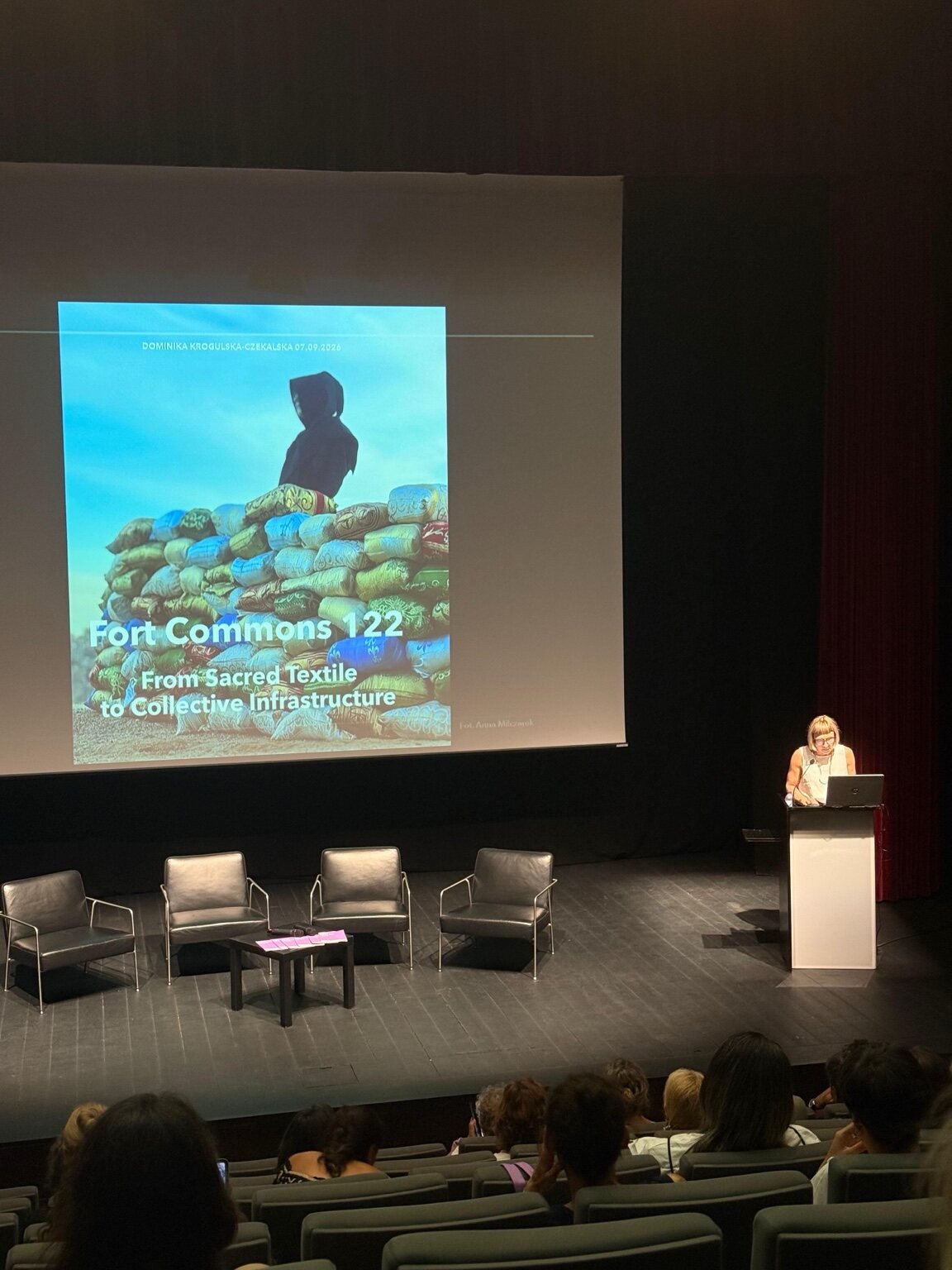
I’d like to begin with the material, because Fort Commons 122 did not begin with an idea for an artwork. It began with textiles that were about to be thrown away.
These were jacquard fabrics produced for liturgical vestments — richly patterned, technically sophisticated textiles intended to become chasubles. There was nothing wrong with them. They were not damaged or worn out. They simply no longer had a purpose, and so they were going to become waste.
I rescued them, but I did not rescue them in order to make Fort Commons 122. I saved them much earlier, simply because I could not accept that such extraordinary textiles were going to be discarded. And then I kept them. For some time, I had no idea what they would become. They were no longer destined to become liturgical vestments, but they had not yet found another purpose. They existed somewhere between the future they had been made for and an unknown one.
This made me wonder: when exactly does a textile become waste? Is waste a physical condition of a material, or is it a status we assign to it?
Who decides that a material no longer has value — and therefore no longer has a future?
These fabrics were particularly interesting to me because they were never neutral. Their ornament, colour, technology and intended function connected them to ritual, hierarchy and institutional authority. Even though they had never become vestments, that identity was already embedded in them.
This is where the idea of the actant becomes useful to me. By actant, I mean something that is not merely acted upon, but also affects what becomes possible. I think of textile not simply as a passive medium, but as something that participates in what a work can become. By rescuing these fabrics, I had preserved not only the material, but also an actant. Their history, technology, symbolism and unrealised function remained in circulation — still capable of entering new relationships and producing new meanings. At that point, however, I had no idea what those relationships might be.
Then I read the open call for Contextile 2026. The theme was By a Thread. The curatorial text described a world stretched almost to breaking point by ecological, political, economic and social crises. But the thread was not only a metaphor for fragility. It also suggested connection, resistance, repair and reconfiguration.
When I read it, the idea came almost immediately. Suddenly, I knew what these fabrics could become: a fort.
I like to think that the work emerged from an encounter — between these particular fabrics and their history, my earlier decision to rescue them, the idea of By a Thread, and the political reality in which I was reading it.
I began sewing the fabrics into sacks resembling sandbags. A sandbag is an extremely simple textile object, but it appears at moments of crisis — during floods, in war, at barricades, around buildings and monuments. It is a form of emergency architecture. This created exactly the tension I was looking for. A textile intended for ceremonial representation was becoming a structure associated with protection and survival.
Surface became structure.
Decoration became infrastructure.
I left the ornament completely visible because the transformation depended on the fabric retaining its previous identity.
There are 122 sacks in Fort Commons 122. The number refers to the 122 cardinals who made up the conclave at the time the work was conceived. It connects the material back to the institutional structure for which it was originally produced.
But I am not interested in making a simple anti-Church statement. What interests me is something more complex: reappropriation. Can material produced within a system of power be taken out of its assigned order and made to function differently? Can material associated with the representation of authority become material for constructing protection? And what happens when it becomes available to a commons?
The idea of the commons was present in the work from the beginning. I was thinking about collective action as a force capable of protecting and sustaining us in moments of crisis. At that stage, however, it existed mainly as a potential — held within the title and the structure of the work.
When we activated Fort Commons 122 in the sand quarry, that potential took material form. The 122 sacks had to be filled with sand, lifted, carried, passed from hand to hand and assembled. A group of people joined me in this physical, repetitive process. What I had first imagined as an idea was now being enacted by bodies. A fort normally suggests defence, separation and control. But this fort emerged through coordination and cooperation. A single sack is not yet a fort. It is through accumulation, relation and collective effort that the sacks become architecture. The commons became visible as a practice.
The activation also led to another collaboration. At first, I asked my friend, film director Barnaba Bonati, to help me document the process. Instead, Barnaba suggested that we meet with cinematographer Artur Frątczak. I told them about the rescued fabrics, the 122 sacks, the fort and the commons, but also about thoughts that had emerged only after I made the work. During that conversation, they immediately began thinking in images: shots, sequences and ways of translating these ideas into film. What had begun as a request for documentation was becoming a creative response to the work itself.
We decided to shoot in a sand quarry, taking all 122 objects back to the material they imitate. The symbolic sandbag was confronted with its own materiality. What emerged was not simply documentation, but a performative activation of Fort Commons 122. The images reveal time, weight, repetition and the movement of the sacks through many hands. The commons is no longer only represented by the fort; it happens through the act of building it.
I find this shift from documentation to interpretation important because it mirrors what had already happened with the textile itself: something enters a new relationship, and that relationship changes what it can become. The fabrics prompted my response. My story prompted the filmmakers’ response. Building the fort brought other people into the process. None of these things happened entirely on its own.
This is very close to how I understand my practice. I use the term post-textile to describe this way of thinking. For me, textile is not simply an autonomous object or a medium onto which meaning is projected. I think of it as a knot of narratives. Material history, technology, labour, institutions, bodies, politics, memory and use can all become entangled within it. I could not have made the same Fort Commons 122 from just any discarded textile. These particular fabrics made this particular work possible.
This brings me back to Textile Waste as Art. Textile waste is not produced only at the moment when a material is discarded. It is also produced by scale — by overproduction, excessive consumption and systems built around constant replacement. For me, the commons names our shared responsibility for these consequences, but also our capacity to respond collectively and participate in repair.
Rescuing textile waste can therefore mean more than keeping material out of the waste stream. Saving the material can also keep the actant in circulation. Its histories, contradictions and associations remain available to enter new relationships. Reuse becomes more than simply giving discarded material a second life. It can mean allowing its previous life to remain present — and using precisely that tension to create something new. In Fort Commons 122, the material moves from a system of representation into a collective structure. It is not destroyed. Its history is not neutralised. It is redirected.
What possibilities remain within a material once a system has decided it no longer has a use for it?
When I rescued these fabrics, I did not know the answer. I did not even know there would be an artwork. I simply prevented one possible ending.
Years later, By a Thread allowed me to see another possibility. From there, other relationships began to form: 122 sacks, many pairs of hands, a fort, a film — a temporary architecture built from material that had once been considered to have no future.
For me, this is where textile waste becomes especially interesting: not when we simply give discarded material another use, but when we allow it — together with everything it carries — to act again, differently.
Participation in Contextile 2026, including the Textile Talks presentation, was made possible thanks to the support of the Adam Mickiewicz Institute through the NetWorks programme.